When Two Worlds Make a Third Thing: The Cross-Cultural Creative Collabs Changing What American Art Looks Like
When Yuki Tanaka and Darius Coleman first met at a community arts residency in Detroit, they didn't have a lot in common on paper. Yuki is a second-generation Japanese American printmaker whose work is deeply rooted in ukiyo-e woodblock traditions. Darius is a self-taught muralist from the city's west side whose visual language draws from Detroit's Black church iconography and the graffiti culture he grew up around.
Their first conversation was awkward. Their first collaboration was worse — a mural concept that neither of them felt good about, trying too hard to split the difference between two aesthetics that didn't naturally overlap.
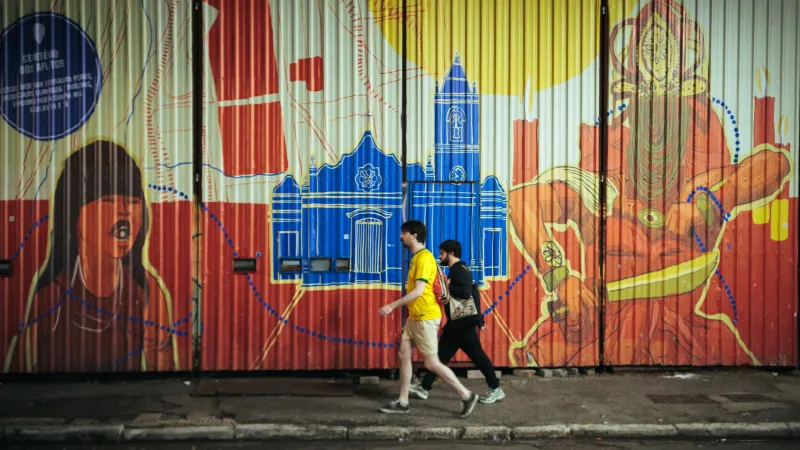
But their third project? That one stopped traffic. Literally. A 60-foot piece on a warehouse wall in the Corktown neighborhood that took bold Japanese compositional geometry and layered it over imagery rooted in the Great Migration — a visual conversation that felt genuinely new, like something that couldn't have existed without both of them in the room.
"We stopped trying to meet in the middle," Darius says. "We started trying to go somewhere neither of us had been."
The Collaboration Economy Is Getting Cultural
Across the US, a growing number of artists, musicians, designers, and entrepreneurs are making intentional cross-cultural partnership a core part of their creative practice — not as a diversity checkbox, but as a genuine creative strategy.
This isn't the cultural fusion of the 1990s, where the goal was often to sand down differences into something palatable for a mainstream (read: white) audience. What's happening now is more deliberate and, frankly, more interesting. These collaborators are leaning into the friction, treating cultural difference as creative tension that generates heat and light.
The results are showing up everywhere: in music that refuses to pick a lane, in fashion that treats heritage as raw material rather than costume, in tech products designed by teams whose cultural diversity directly shaped the user experience. The market is noticing too. Some of the most buzzed-about creative projects of the past few years have emerged from exactly these kinds of cross-cultural partnerships.
Friction as a Feature
Saanvi Mehta and Lucia Flores didn't plan to start a business together. They met in a graduate design program in Los Angeles and kept arguing about everything — color theory, typography, what "accessible design" actually meant in practice.
"We had completely different intuitions," Saanvi says. "My design sensibility comes from this very specific South Asian visual tradition — dense, layered, maximalist. Lucia's comes from Mexican folk art and mid-century California modernism. We could not agree on anything."
So they leaned into it. Their studio, Doble, now produces branding and visual identity work for cultural organizations, restaurants, and community nonprofits — clients who specifically want design that doesn't look like it came from a generic agency template. Their signature style is immediately recognizable: it shouldn't work, and it absolutely does.
"We say we make things that look like they're arguing with themselves," Lucia laughs. "Clients who get it, get it immediately."
This approach — treating cultural difference as a design input rather than a complication to manage — is gaining traction in innovation circles too. Research from a number of business schools has consistently found that teams with high cultural diversity outperform homogeneous ones on creative problem-solving tasks, particularly when the team has learned to navigate conflict productively.
The key phrase there is learned to navigate. Diverse teams don't automatically produce better work. They produce better work when they've developed the trust and communication tools to make use of their differences.
Where These Partnerships Are Forming
So where are these collaborations actually happening? Community arts organizations are doing a lot of the heavy lifting. Residency programs that deliberately bring together artists from different backgrounds — and then give them enough unstructured time to actually get to know each other — are producing some of the most interesting cross-cultural work in the country right now.
Cultural festivals and community events are another incubator. The informal networking that happens when people from different communities share a physical space, especially around creative work, generates the kind of casual relationship-building that formal programming can't manufacture.
Online platforms are playing a role too, though the dynamics are different. Digital collaboration tools have made it easier than ever for a musician in Miami and a visual artist in Minneapolis to build a working creative relationship — but the most generative partnerships still seem to happen when there's real-world proximity involved at some point.
What Gets Made That Couldn't Otherwise Exist
Back in Detroit, Yuki and Darius have completed six collaborative projects now. They've developed what they call a "translation practice" — a set of questions they ask each other before starting any new piece: What does this image mean in your tradition? What does it mean in mine? Where do those meanings overlap, and where do they diverge?
The divergences, they've found, are where the interesting stuff lives.
"There's this concept in Japanese aesthetics called ma — the meaningful pause, the space between things," Yuki explains. "And when I tried to explain that to Darius, he immediately connected it to the rests in jazz. The silence that gives the notes meaning. We spent three hours just talking about that one idea. And then we made a whole series of work about it."
That series is now touring community arts spaces in four cities.
The work that emerges from genuine cross-cultural creative partnership isn't a blend or a compromise. It's a third thing — something that carries the DNA of both traditions while belonging fully to neither. In a country still working out what its shared culture actually is, that third thing might be exactly what we need more of.