Words Without Borders: The Community Movement Rescuing Concepts English Can't Contain

There's a moment most multilingual people know well. You're trying to explain something to a friend — a feeling, a vibe, a way of moving through the world — and halfway through the sentence you just stop. Because the word for it exists. Just not in English.
That pause, that small linguistic gap, is exactly what a growing number of community organizers across the United States are turning into something meaningful. They're building archives, hosting workshops, running Instagram pages, and gathering in community centers to document and celebrate the words their heritage languages carry that English simply doesn't have room for. And what started as a kind of cultural housekeeping has quietly become one of the more quietly radical acts of community-building happening right now.
More Than a Word Problem
Let's be clear about what we're actually talking about here. Untranslatable words aren't just linguistic curiosities — they're windows into entirely different ways of organizing reality.
Take the Japanese concept of ma (間). Roughly, it refers to the meaningful pause or negative space between things — the silence between notes in music, the gap between objects in a room, the breath before a response in conversation. There's no clean English equivalent because, as many Japanese Americans will tell you, English-speaking culture doesn't tend to treat emptiness as something with value. Ma says: the space between things is a thing.
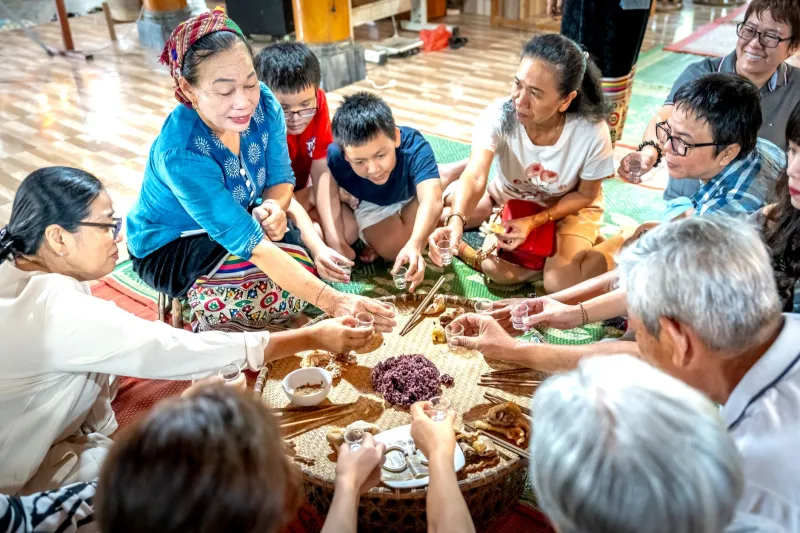
Or consider the Spanish sobremesa — that extended, unhurried stretch of time after a meal when nobody gets up, the food is mostly gone but the conversation has only just gotten good. English has "lingering," sure, but sobremesa implies intention. It's not an accident you're still at the table. It's the whole point of the table.
These aren't just fun facts. They're philosophical positions encoded in vocabulary. And community groups are starting to treat them that way.
The Archivists in Your Neighborhood
In Chicago's Pilsen neighborhood, a group of Mexican American residents has been running informal sobremesa circles for the past two years — gatherings explicitly named after the concept, where neighbors share untranslatable words from their family's Spanish dialects alongside the stories attached to them. The goal isn't just preservation. It's translation in the deeper sense: helping non-Spanish-speaking neighbors actually feel what the word means by experiencing the thing itself.
"You can define sobremesa in a sentence," one of the organizers explained at a recent community event. "But if you sit with us for two hours after dinner just talking, you don't need the definition anymore."
Similar projects are popping up in cities with dense immigrant and second-generation communities. In the San Francisco Bay Area, a Japanese American cultural nonprofit has been building a community-sourced glossary of Japanese concepts — wabi-sabi, ikigai, amae — with contributions from community members who share not just definitions but personal stories of when and how these words showed up in their lives. The result is less a dictionary and more a living memoir.
In New York's Jackson Heights, a multilingual collective has launched what they're calling a "word lending library" — a physical installation at a local community center where visitors can pull cards bearing untranslatable terms from Hindi, Bengali, Nepali, and Spanish, each one accompanied by a short essay written by a community member. The cards get borrowed, shared, brought home. Some come back with handwritten notes added.
Going Viral Without Losing the Plot
Social media has become a surprisingly effective venue for this kind of cultural work — though not without its complications.
Accounts dedicated to untranslatable words have accumulated substantial followings on Instagram and TikTok, with posts about terms like the Portuguese saudade (a melancholy longing for something beloved that may never return), the Danish hygge (cozy, convivial warmth), or the Filipino gigil (the urge to squeeze something unbearably cute) regularly racking up hundreds of thousands of views.
But the community organizers doing the deeper archival work are quick to point out a difference between virality and understanding. "When a word gets turned into an aesthetic, you lose the culture it came from," one Bay Area organizer noted. "Hygge became a candle brand. That's not what it is."
The more intentional social media projects treat each word as an entry point rather than a destination — linking to community events, oral history recordings, or written reflections from heritage speakers. The goal is to pull followers toward something more substantial than a pretty graphic.
Language Workshops as Cultural Diplomacy
Some of the most interesting work is happening in structured educational settings that don't look much like classrooms. Community centers, libraries, and cultural organizations in cities from Atlanta to Minneapolis are hosting what you might call "concept workshops" — sessions built not around grammar or vocabulary drills but around the experience of a single untranslatable idea.
One recurring workshop format involves pairing heritage speakers with community members from entirely different backgrounds and asking each person to teach the other a word that doesn't cross language lines cleanly. The exchange tends to go places that standard cultural programming doesn't. When a Somali American woman explains xishood — a concept combining dignity, modesty, and social awareness — to a third-generation Italian American neighbor, and that neighbor responds with sprezzatura (the art of making difficult things look effortless), something happens in the room that's hard to describe in any language.
Which, honestly, might be the point.
What These Words Are Actually Doing
There's a practical argument for this work beyond the cultural richness angle. In a country that often defaults to a single dominant linguistic and cultural framework, untranslatable words do something quietly subversive: they make visible the fact that other frameworks exist and are coherent and complete on their own terms.
When a community can say "we have a word for that feeling, and here's what it reveals about how we see the world," they're not just sharing vocabulary. They're asserting that their way of understanding things is worth taking seriously — not as a colorful addition to the American mainstream, but as a legitimate lens in its own right.
And for the neighbors, coworkers, and fellow Americans who encounter these words for the first time, the experience can be genuinely disorienting in the best way. Learning that mono no aware exists — the Japanese bittersweet awareness of impermanence, the ache of beautiful things passing — doesn't just add a word to your vocabulary. It might add a feeling you didn't know you were allowed to have.
A Living Archive
What makes this movement feel different from, say, a linguistics textbook or a viral listicle is that it's rooted in people and place. The words being documented aren't abstract — they're attached to grandmothers, to specific kitchens, to arguments and reconciliations and Sunday afternoons. The archives being built aren't just collections of definitions. They're community memory in linguistic form.
And as second- and third-generation Americans navigate what it means to hold multiple cultural identities at once, having access to the vocabulary of those identities — even the untranslatable parts, maybe especially the untranslatable parts — turns out to matter quite a bit.
Some things, it seems, are worth keeping even when you can't quite explain them. Or maybe because you can't.