Sacred Plates: Inside the Interfaith Families Turning Dinner Into a New American Ritual
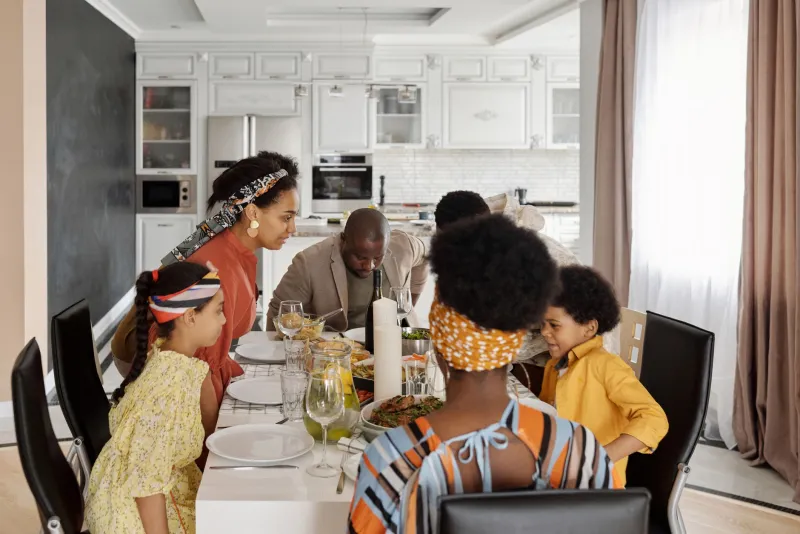
Somewhere between the challah and the biryani, Priya Okonkwo figured out that dinner at her house was never going to be simple — and she stopped wanting it to be.
Priya, a Hindu woman from New Jersey whose husband Emmanuel is Nigerian-American and Baptist, and whose mother-in-law is a devout Muslim who moved in three years ago, describes their Sunday dinners as "a beautiful negotiation that nobody wins and everybody wins." The table holds no beef (out of respect for Priya's faith), no pork (out of respect for Emmanuel's mother), and somehow, impossibly, it holds everyone.
"We stopped thinking of it as a problem to solve," Priya says. "Now we think of it as a tradition we're building from scratch. Which is actually kind of exciting."
This is happening at kitchen tables all across America — quietly, practically, and with a lot of improvisation. As interfaith households become more common (Pew Research has consistently shown that roughly four in ten American adults who have married since 2010 have a spouse from a different religious background), the dinner table has emerged as one of the most intimate arenas where that diversity plays out in real time.
The Logistics Are Real — and So Is the Love
Anyone who's tried to cook for a group with mixed dietary restrictions knows the math gets complicated fast. Now layer in religious observance. Kosher laws prohibit mixing meat and dairy. Halal requirements restrict certain animals and preparation methods. Some Hindu traditions avoid beef or all meat entirely. Jain dietary practice eliminates root vegetables. Seventh-day Adventist households may follow vegetarian or clean-eating guidelines. And that's before anyone mentions gluten sensitivities or a teenager who just went vegan.
For Marcus and Leila Bernstein-Khalil in Chicago, feeding their combined family of Jewish, Muslim, and secular members at Thanksgiving required what Marcus calls "a full whiteboard session" the first year. "We had to figure out which dishes could be shared, which needed to be separate, and how to make sure nobody felt like a footnote at their own holiday meal."
Their solution? A modular table setup where dishes are clearly labeled, proteins are kept entirely separate, and the communal centerpieces — roasted vegetables, grain salads, fresh bread — are built to work across every restriction at the table. "The bread thing was actually the breakthrough," Leila laughs. "Both traditions have a deep relationship with bread. That felt like holy ground we could all stand on."
When the Ritual Is the Point
Beyond the logistics, what strikes many of these families is how the act of trying — of genuinely working to honor each other's practices — becomes its own kind of ceremony.
In Atlanta, the Rodriguez-Kim family has developed what they call their "opening round," a few minutes before each major shared meal where whoever wants to can offer a blessing, a prayer, a moment of silence, or just a word of gratitude — in whatever tradition feels true to them. Maria Rodriguez, who is Catholic, says her Korean-American mother-in-law's Buddhist-inflected moment of stillness before eating has actually changed how she approaches her own prayer. "It slowed me down. Made me more present. I didn't expect to learn something new about my own faith from a meal."
That cross-pollination is something researchers who study religious pluralism have noted with interest. When people share food in contexts that honor multiple traditions simultaneously, the experience tends to produce what sociologists call "positive contact" — the kind that doesn't flatten differences but actually deepens mutual understanding precisely because the differences are visible and respected.
The Kids Are Watching
For families raising children across multiple traditions, these meals carry an outsized significance. Kids who grow up watching adults navigate competing spiritual frameworks with care and creativity tend to develop a more nuanced relationship with identity — both their own and others'.
Deandra Washington, who is raising her two daughters in a household that practices both her Baptist faith and her husband's Sikh traditions, says the dinner table has become her primary teaching space. "My oldest asked me once why we say grace and do the Ardas prayer before some meals. And I told her: because we have two families who love us, and we want to honor both of them. She thought about it and said, 'So we're doubly blessed?' I mean — yes. Exactly."
That reframe — from complexity as burden to complexity as abundance — shows up again and again in conversations with these families. The initial friction of navigating different rules and rituals often gives way to something that feels, over time, genuinely enriching.
Ripple Effects Beyond the Front Door
What's interesting is how these private dinner-table negotiations are beginning to influence community spaces too. Some interfaith families have started hosting open meals — potlucks, holiday celebrations, or just casual Saturday dinners — that invite neighbors, friends, and colleagues into the same kind of multi-tradition hospitality they've developed at home.
In Minneapolis, a loose collective of interfaith couples has been organizing quarterly "open table" dinners for the past two years, drawing attendees from across the religious and cultural spectrum of their neighborhood. The events are deliberately low-key — no panel discussions, no formal programming — just food, conversation, and the implicit message that a table big enough for everyone's traditions is a table worth building.
"We're not trying to solve anything," says one of the organizers, who asked to be identified only as Fatima. "We're just showing that it's possible. That you can sit down together and eat together and nobody has to disappear."
What American Hospitality Could Look Like
There's a version of American hospitality that's always been about abundance — the groaning table, the open door, the more-the-merrier ethos. But the families rewriting their dinner traditions are pointing toward something a little more specific: hospitality as attentiveness. The idea that welcoming someone fully means learning what they need, adapting to meet them there, and finding the dishes — literal and figurative — that belong to everyone.
Priya Okonkwo puts it simply: "The best compliment I ever got was from Emmanuel's mom, after she'd been living with us for about six months. She said, 'I never feel like a guest here.' That's it. That's the whole goal."
The dinner table has always been where families figure out who they are. For a growing number of American households, it's also where they're figuring out who we could be — one shared meal at a time.